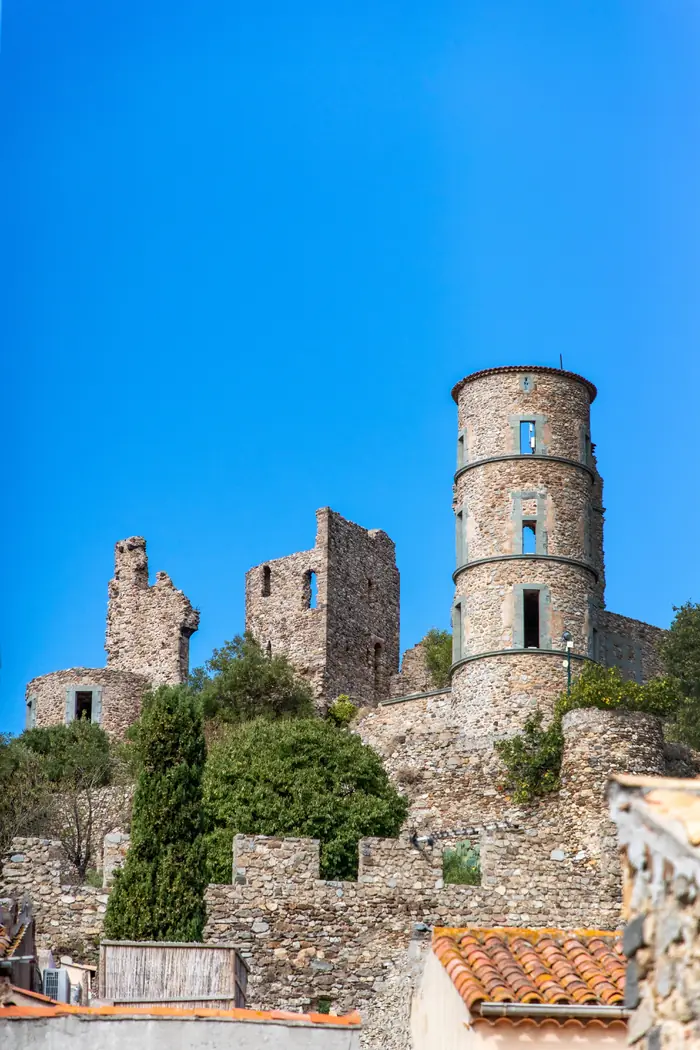
There is a particular quality of light in Grimaud at the end of a June afternoon — the kind that turns limestone a shade of warm amber and makes the ruined towers of the château above the village look less like a wound in the hillside and more like a deliberate punctuation mark. The village itself is one of those places in the Var that has resisted the coastal drift toward spectacle; its medieval lanes, stacked vertically toward the castle keep, still belong more to the eleventh century than to the twenty-first. It is the right setting, in other words, for a conversation about what time takes away.
On Saturday, 13 June 2026, at 19:00, the Salle Beausoleil — located at 850 Route Nationale in Grimaud — hosts a lecture dedicated to the history of the Château de Grimaud. Attendance is by reservation. The format is a conference, a single evening of sustained attention rather than a festival or a guided tour, and that restraint is part of the point.
What the Archives Could Not Keep
The premise of the evening is, in itself, a kind of historical drama. A large part of the château's archives have disappeared over the centuries, leaving researchers and local historians to work with fragments: scattered documents, material traces in the stonework, the occasional record that survived fire, flood, or the ordinary entropy of neglect. The conference sets out to trace what can still be known — certain aspects of daily life within the fortress walls, the different periods that shaped its evolution — and to be honest about the gaps.
That honesty is rarer than it sounds. The Château de Grimaud dates to the medieval period and occupies a commanding ridge above the village, visible for miles across the plain toward the Gulf of Saint-Tropez. It passed through the hands of various lords and was the seat of local power across several turbulent centuries — the kind of structure that accumulates history the way a cliff face accumulates strata. Yet the loss of so much documentary evidence means that the castle's story has often been told in outline rather than in detail, the biography of a public figure reconstructed largely from rumour and official portraits.
'Une grande partie de ses archives ont disparu, ce qui rend la compréhension de son développement difficile.'
The lecture draws on the documents that do survive — a series of sources that allow certain aspects of the château's history to be retraced, touching on its daily rhythms and the periods that marked its development. The emphasis on 'lesser-known aspects' suggests that even those who believe they know the site may find the evening revises their understanding.
Archaeology, Heritage, and the Patience of Stone
The keywords attached to this event — archaeology, archives, heritage, ruins — point toward a particular mode of historical inquiry, one that combines the close reading of written sources with the physical evidence of the structure itself. The château's ruins are classified among France's historic monuments, and the village of Grimaud takes its patrimoine seriously; the conference is part of a broader culture of careful attention to what the landscape holds.
For a visitor arriving from the coast — from Saint-Tropez twenty minutes to the south, or from the busy summer circuit of the Golfe — Grimaud offers something the shoreline rarely does: the sensation of a place that has not been entirely explained. The castle on the hill is a presence rather than a destination, and an evening spent listening to what the surviving documents reveal — and what they conspicuously do not — is a different kind of travel altogether.
The Salle Beausoleil is an accessible, practical venue at the edge of the village, the sort of room that disappears once the speaker begins and the slides appear. Bring the patience the material demands, and perhaps a cardigan; June evenings in the Var can turn cool once the sun drops behind the ridge. Reservations are required — details available through the standard local cultural channels — and the audience is likely to be a mix of residents, historians, and the kind of traveller who prefers a lecture to a cocktail hour.
There are castles along this coast that have been thoroughly interpreted, every arrow-slit explained, every noble name accounted for. Grimaud's fortress is more interesting precisely because it is not. The conference on 13 June does not promise resolution. It promises, instead, a careful look at what remains — and that, for anyone who finds the past genuinely compelling, is quite enough.