There is a particular quality of light in Fréjus in early summer — sharp, almost white by mid-morning, softening the ochre of old stone without quite forgiving it. The town sits between the Maures massif and the Mediterranean, and it carries its age lightly: Roman amphitheatre, aqueduct, episcopal complex — the bones of Forum Julii are never far from the surface. It is fitting, then, that the place where those bones are most carefully tended stands quietly on the Place du Docteur Calvini, asking nothing more of a visitor than curiosity.
On 13 and 14 June 2026, the Musée archéologique de Fréjus opens its doors for free public visits — no reservation, no admission charge specified. Doors open at 8 a.m. on both days. It is a rare chance to spend time with a collection that, on an ordinary afternoon, might pass beneath the radar of travellers more drawn to the coast a few kilometres south.
What the Museum Holds
The museum's holdings were assembled from archaeological excavations conducted in and around Fréjus from the nineteenth century onward, with significant additions from late-twentieth-century digs whose findings sharpened the scholarly picture of the city's Roman past considerably. What you find inside is not a generic survey of Roman antiquity but something more particular: objects that came out of this specific ground, from this specific colony.
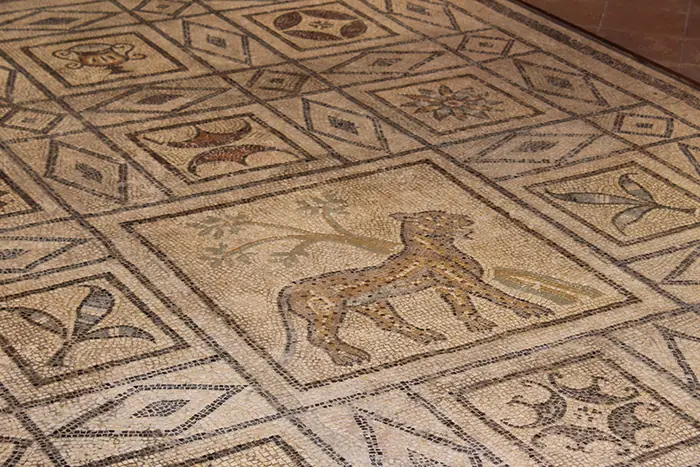
The collection spans three broad registers. Statuary — fragments and near-complete figures — occupies the eye first; Roman civic and religious sculpture in Provence had its own regional inflections, less imperial in register than Rome, more attuned to local patronage. Alongside the statuary, architectural decoration speaks to the ambition of Forum Julii's public monuments: carved friezes, column capitals, decorative elements that once belonged to buildings whose footprints are still being mapped. Then there are the mosaics — floor compositions whose geometry and palette carry the full vocabulary of Roman domestic taste into a Mediterranean context where colour and durability were equally prized.
'Les collections reflètent la diversité des techniques artistiques mises en œuvre par les Romains' — and in a town where the amphitheatre still hosts summer concerts, that diversity feels less like history than like continuity.
Forum Julii, Then and Now
Fréjus was founded by Julius Caesar and developed under Augustus as a naval base — its Latin name, Forum Julii, signals both its function and its founder. At its height it controlled a sheltered harbour (long since silted over), housed a substantial garrison, and generated the kind of civic building programme that left archaeology something to work with for centuries. The town's Roman infrastructure — aqueduct, arena, theatre, the outline of city walls — survives in a state that makes Fréjus one of the more legible Roman sites in southern France, even if it rarely commands the same tourist attention as Arles or Nîmes.
The museum, housed on the Place du Docteur Calvini, acts as the interpretive anchor for all of this. The late-twentieth-century excavations referenced in the collection's provenance were not merely additive; they reframed understanding of how the city developed, contracted, and persisted through late antiquity. Individual objects in the galleries carry that weight — a mosaic fragment is also a stratigraphic argument, a piece of statuary a clue to which families were commissioning what, and when.
What a visitor encounters on 13 or 14 June, then, is not simply Roman decorative art displayed in a provincial museum. It is a conversation between the objects themselves and the landscape they came from — one that rewards a slow circuit of the galleries rather than a brisk pass-through. Fréjus is small enough that the museum visit pairs naturally with a walk to the amphitheatre or along the surviving section of aqueduct; the town does not require a full day to cover, but it repays the kind of attention that a free admission day quietly encourages.
June in the Var is warm and increasingly busy as the coast fills for the season, but Fréjus — inland enough, Roman enough, unhurried enough — tends to offer a different tempo. The museum on the Place du Docteur Calvini will be open. The light will be doing what it does. The stone will be waiting.