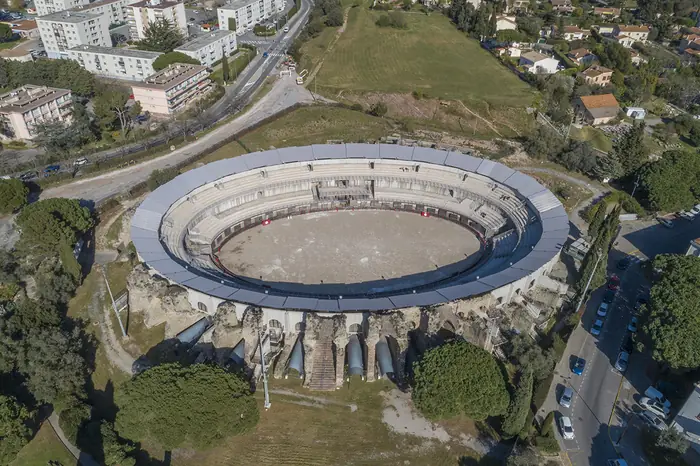
There is a particular quality of light in Fréjus on a June afternoon — dense, almost honeyed, the kind that makes ancient masonry glow as though lit from within. Standing at the edge of the arena at 296 Rue Henri Vadon, where the curved walls of the Roman amphitheatre rise against a sky of uncompromising blue, it is not difficult to believe that this city has been staging spectacles for the better part of two millennia. The stone remembers.
Forum Iulii, Revisited
On Saturday 13 June 2026, the amphitheatre opens for two guided visits — at 14h30 and again at 16h00 — focused on its archaeological and architectural evidence. The sessions are presented under the title 'Données archéologiques et architecturales', which signals, precisely, their register: this is not a theatrical re-enactment but a careful, expert-led reading of what the structure itself can tell us. The venue is the Amphithéâtre romain, also known locally as the Arènes, administered by the city of Fréjus.
Fréjus — ancient Forum Iulii — was founded by Julius Caesar and later developed under Augustus into one of the most significant Roman ports in Gaul. The amphitheatre dates to the late first century CE and, at its peak, could hold more than 10,000 spectators. That figure, set against a modern town of roughly 55,000 inhabitants, gives a sense of the scale of Roman ambition here. The arena was designed to host the popular entertainments that structured civic life: the games, the spectacles, the communal rituals of a society that understood very well the politics of the crowd.
'Conçu pour accueillir les manifestations populaires au temps de Forum Iulii, l'amphithéâtre a traversé les siècles au grès de multiples vicissitudes.'
What makes this particular visit worth marking in the diary is precisely the phrase 'multiples vicissitudes.' The amphitheatre did not arrive at the present day intact and pristine. It has been repurposed, damaged, partially dismantled, and — in more recent decades — conserved and, in places, interpreted by contemporary architects. The guided tour engages with all of this honestly: the original Roman fabric, the traces of subsequent centuries, and the visible interventions of modern conservation. That layering is, in many ways, more revealing than a perfectly preserved ruin would be.
What the Walls Say
For a visitor with even a passing interest in how buildings age and are kept alive, the amphitheatre at Fréjus is a genuinely instructive case. Roman amphitheatres follow a recognisable typology — the elliptical plan, the tiered seating cut into or built above the earth, the system of vaulted passageways that controlled the flow of thousands of bodies — but each site carries its own specific biography. Here, that biography is long and, by the description of the tour itself, complex.
The visit offers something that independent exploration rarely can: a guide who can distinguish between original Roman stonework and later additions, who can explain what a particular repair tells us about a particular period, and who can point to where contemporary architects have made deliberate, legible choices rather than attempting invisibility. In a country where the conversation between heritage and contemporary intervention is often heated, the amphitheatre at Fréjus is a quiet but substantive contribution to that debate.
Practically speaking, visitors should expect the following from the afternoon:
- Two time-slots: 14h30 and 16h00, each a separate commented visit
- The focus is archaeological and architectural data — the tour is analytical in tone
- The setting is an outdoor Roman monument; June temperatures in Fréjus routinely exceed 25°C, so light clothing and sun protection are advisable
- Full details on conditions and booking are available at the city's heritage site: https://www.ville-frejus.fr/archeologie-et-patrimoine/musees-et-monuments/amphitheatre
Fréjus itself rewards a longer stay. The Roman heritage here extends well beyond the arena — the city retains substantial traces of its ancient walls, an aqueduct, a theatre, and one of the oldest baptisteries in France, dating to the fifth century. The old town, compact and navigable on foot, sits only a few kilometres from the coast, which means that an afternoon among Roman stones can reasonably end with an aperitif above the Golfe de Fréjus as the light finally softens.
There is something clarifying about standing inside a structure that was already old when the medieval world was young. The amphitheatre at Fréjus does not ask you to imagine the past; it simply presents the evidence, layer by layer, and invites you to look carefully. On a June afternoon, with a knowledgeable guide and two thousand years of stone around you, that is more than enough.