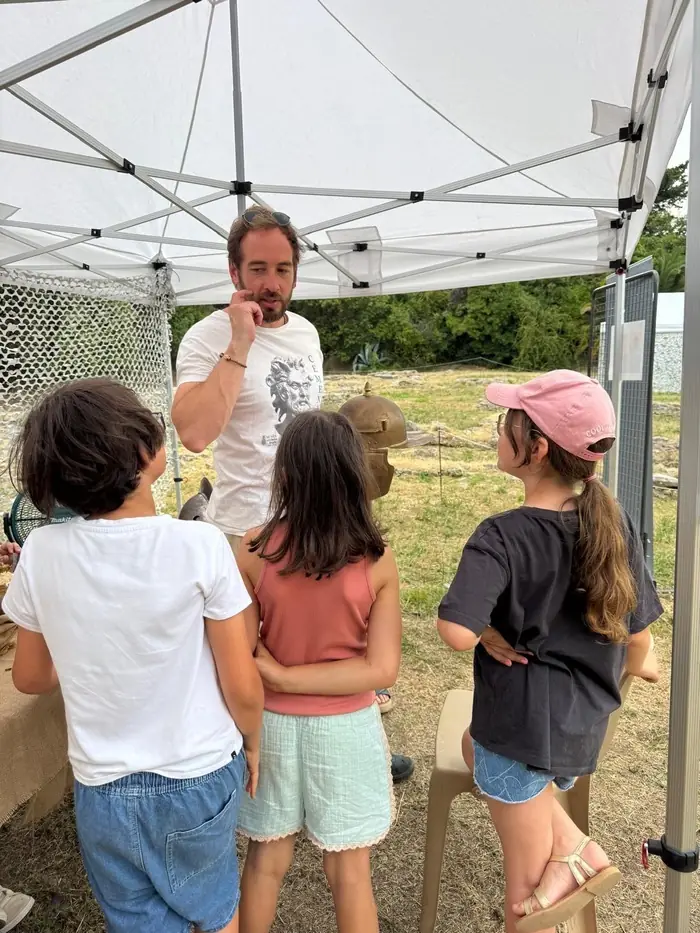
There is a particular quality of light in Cimiez on a June morning — filtered through umbrella pines, cooled by the altitude of the hill that rises above the Promenade des Anglais and the whole restless machinery of the coast below. Up here, the city slows. The Roman arena sits in its garden. The Franciscan monastery keeps its silence. And the Musée Archéologique de Cimiez, tucked into the hillside at 160 avenue des Arènes de Cimiez, holds its long memory of a place that was already old when Nice was young.
On 13 and 14 June 2026, the museum's mediators will step outside the glass cases and into something more elemental. The workshop — Produire du feu à la préhistoire — traces the complete arc of fire-making as it was practiced in prehistory: from the selection of the right stone to the moment a flame takes hold. No matches. No lighters. The demonstration runs across both days, beginning at 8:30 in the morning, when the hill is still cool and the light still oblique.
A Hill with a Long Memory
The museum sits on ground that was once Cemenelum, the Roman capital of the province of Alpes Maritimae — a city that predates the medieval town of Nice itself. Its collections were assembled largely from excavations conducted between 1950 and 1969, when the municipality acquired the site and archaeologists began recovering the material record of daily and official life here: inscriptions, ceramics, personal objects, civic documents. Among the pieces on display are finds from the shipwreck of the Fourmigue C, recovered off Golfe-Juan, which extend the museum's reach beyond the hill and into the maritime world that always surrounded this coast.
To stand in those galleries is to hold two timelines at once: the Roman city that organised this hillside into forums and baths and administrative order, and the far longer prehistoric span that preceded it. The fire-making workshop belongs to that deeper layer — the era before metallurgy, before writing, before the province had a name.
'Du choix de la pierre jusqu'à la flamme' — from the choice of stone to the flame itself — the demonstration follows each step as the museum's own mediators work through it.
What the Demonstration Involves
The workshop is led by the museum's own mediators, who will walk visitors through the reasoning and the technique behind prehistoric fire production. The process begins with material selection — not every stone will do — and proceeds through the physical steps that transform raw geology into combustion. For visitors accustomed to thinking of fire as something summoned instantly, watching it coaxed slowly from flint and tinder recalibrates the sense of what skill and patience once meant in daily life.
This is the kind of demonstration that rewards attention. The mediators are not performing a spectacle; they are reconstructing a practice, and the difference is legible in the way they work. Children tend to go very quiet. Adults, often, do too.
The museum's setting amplifies the effect. The Roman ruins are visible from the garden. The pine trees are old. The neighbourhood of Cimiez has a residential calm that the seafront long ago surrendered to tourism, and the museum sits within that calm like a well-kept secret — which, for many visitors to Nice, it still is.
Admission conditions for the workshop are not specified in advance; the museum's website at nice.fr carries current visitor information. The event is free to attend in the sense that Cimiez itself is free: you arrive on foot or by bus up the hill, you spend a morning among things that have lasted, and you leave knowing something you did not know before — in this case, how much a fire once cost to make.