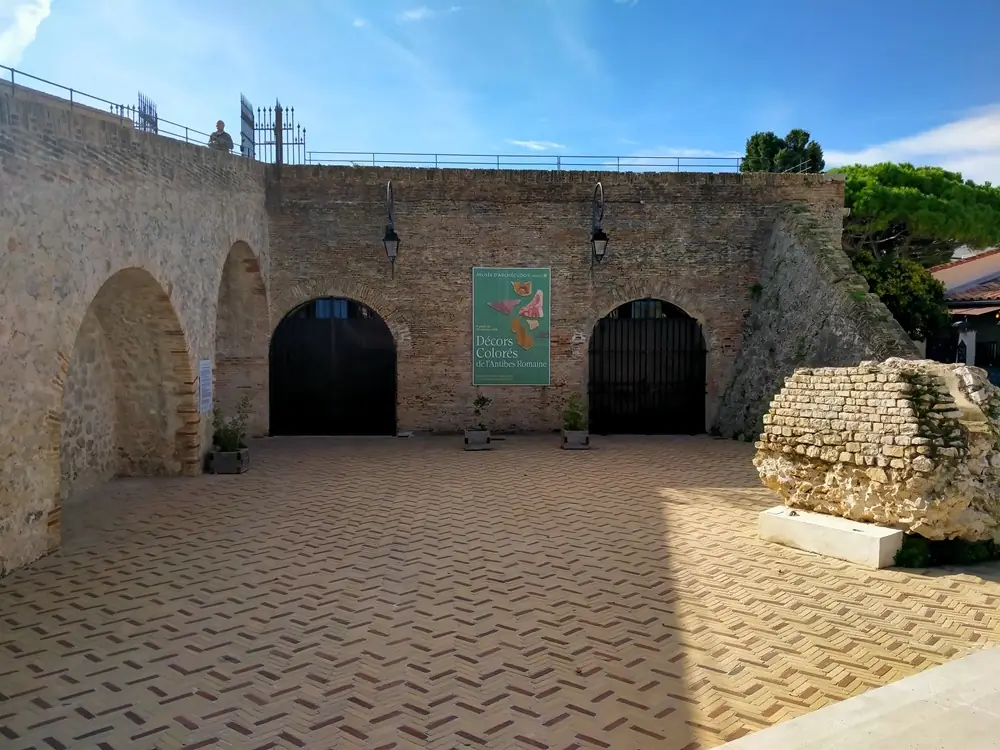
There is a particular quality of light in Antibes on a June morning — low and salt-bright, the kind that makes limestone walls glow almost white before the heat settles in. The old town sits on its headland above the Mediterranean, and beneath it, in layers of earth and sediment, lie twelve centuries of human occupation. The Musée d'Archéologie on Avenue Général Maizière holds much of what has been recovered: amphorae, bronze fibulae, coins, the quiet residue of a city the Greeks called Antipolis. On the weekend of 13 and 14 June 2026, the museum adds something rarer to its programme — a chance to work with the evidence yourself.
The workshop is called Atelier Les experts — anthracologue, and the premise is precise: participants examine the charcoal remains of a funerary pyre and learn to make them speak. Anthracology — the scientific analysis of archaeological charcoal — is one of the quieter disciplines of the field, less photogenic than ceramics or bronze-work, but no less revelatory. A fragment of charred wood, correctly read, can identify the species of tree that burned, suggest the season of the fire, and sketch the landscape that surrounded a burial site two thousand years ago. The session opens at 08:30 on both days and is open to anyone aged eight and over, subject to available places.
The City Beneath the City
Antibes has been continuously inhabited since at least the seventh century BCE, when Greek colonists from Massalia — present-day Marseille — established a trading post on the cape. The Romans followed, and then late antiquity folded in over them. The Musée d'Archéologie, inaugurated in 1963, was built to hold the material evidence of that long sequence: objects recovered from both terrestrial excavations and underwater digs in the bay, where the sea floor has preserved things the land could not. The collection spans from the archaic Greek period through to the fifth century CE — roughly twelve hundred years compressed into a single building on a quiet avenue a short walk from the ramparts.
It is in that context that the anthracologist's work takes on particular weight. The funerary rites of Antipolis are not fully understood. Cremation was practised across the Greek and Roman worlds, but the specifics — which woods were chosen, whether choice was ritual or practical, what the pyre's remains were then done with — varied by community, period, and social circumstance. Charcoal, when it survives, is one of the few materials that can begin to answer those questions.
'Venez expertiser un bûcher funéraire et faire parler les charbons archéologiques.' — the museum's own framing of the workshop, and a quietly ambitious one.
What the Workshop Offers
The session is structured as a hands-on exercise rather than a lecture. Participants work with archaeological charcoal samples, learning the identification techniques that anthracologists use in the field and laboratory. The format — Les experts — is the museum's recurring series of specialist-led practical workshops, each built around a specific scientific discipline used in archaeology. Previous editions have introduced participants to other analytical methods; this one focuses on the evidence left by fire.
For families, the age threshold of eight reflects the museum's genuine commitment to making analytical science accessible rather than merely decorative. The work is careful and slow — the kind that rewards attention over speed. Children who have spent time with magnifying glasses or field guides will find the material tractable; adults with no prior archaeology background have found these sessions equally absorbing, because the logic of the method is self-evident once demonstrated.
Practical details worth noting:
- Dates: 13 and 14 June 2026, starting at 08:30
- Venue: Musée d'Archéologie, 1 Avenue Général Maizière, 06600 Antibes
- Admission: free, open to all from age eight, places limited
- Booking is advised given capacity constraints
Antibes itself is easy to reach — the train from Nice takes under thirty minutes, and the old town is walkable from the station. June brings warm, settled weather to the coast, and the museum's position near the Bastion Saint-André means there is good reason to linger in the area before or after the session. The market on Cours Masséna runs on weekend mornings; the ramparts offer a view of the bay that has changed less than one might expect.
Archaeology is often presented as a story about objects — the amphora, the mosaic, the sword. The anthracologist's work is a reminder that the story also lives in what burned, in the wood chosen or at hand, in the fire that was lit and then went cold. To sit with those fragments in a museum built above twelve centuries of occupation, on a headland the Greeks first settled before Rome was an empire, is to understand that the distance between then and now is mostly a matter of what we have learned to read.