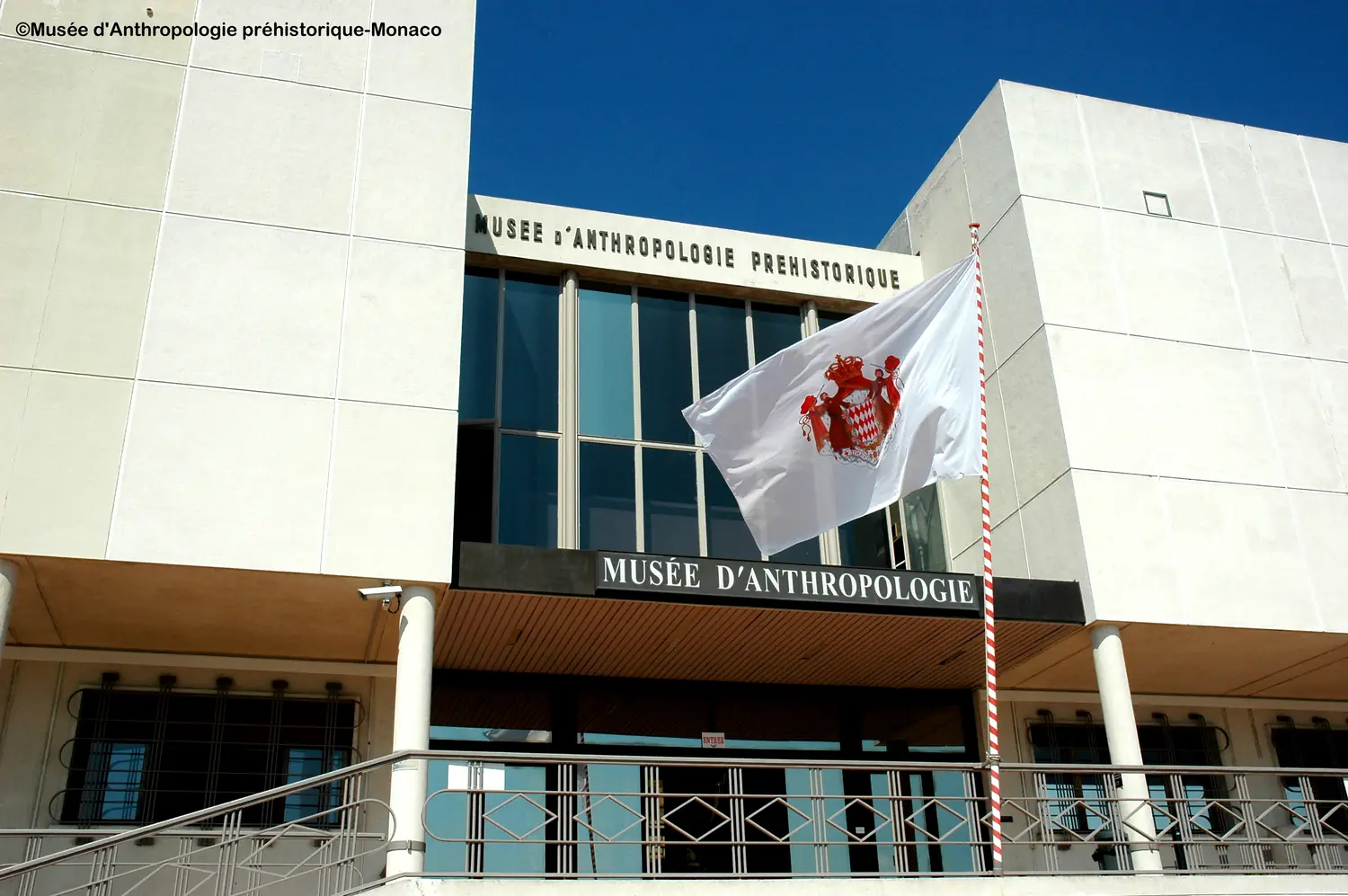
There is a particular quality of light on the hillside above Monaco in early June — warm but not yet punishing, filtered through the succulent canopy of the Jardin Exotique. Climb to the garden's edge, follow the Boulevard du Jardin Exotique to number 56 bis, and you arrive somewhere that quietly reframes everything the Riviera is supposed to be about. No yachts, no rosé, no belle-époque façades. Instead: a million years of human habitation, pressed into bones and flint and pigment, held in rooms that smell faintly of stone.
The Musée d'Anthropologie Préhistorique de Monaco was founded in 1902 by Prince Albert I — oceanographer, Arctic explorer, and one of the more scientifically serious monarchs of his era — with the express purpose of preserving the remains of 'primitive humanities' unearthed from the soil of the Principality and its surrounding regions. In 1959, Prince Rainier III relocated the institution to its current home within the Jardin Exotique, in a building designed by the Monegasque architect Louis Rué. It is not a decorative museum. It is a working research institute, conducting field excavations, publishing an annual scientific bulletin, and maintaining an international scientific committee. The collections it holds tell a story that dwarfs the principality's famous modernity: that the Côte d'Azur was already a preferred habitat for our distant ancestors more than a million years ago.
A Day Without a Ticket Price
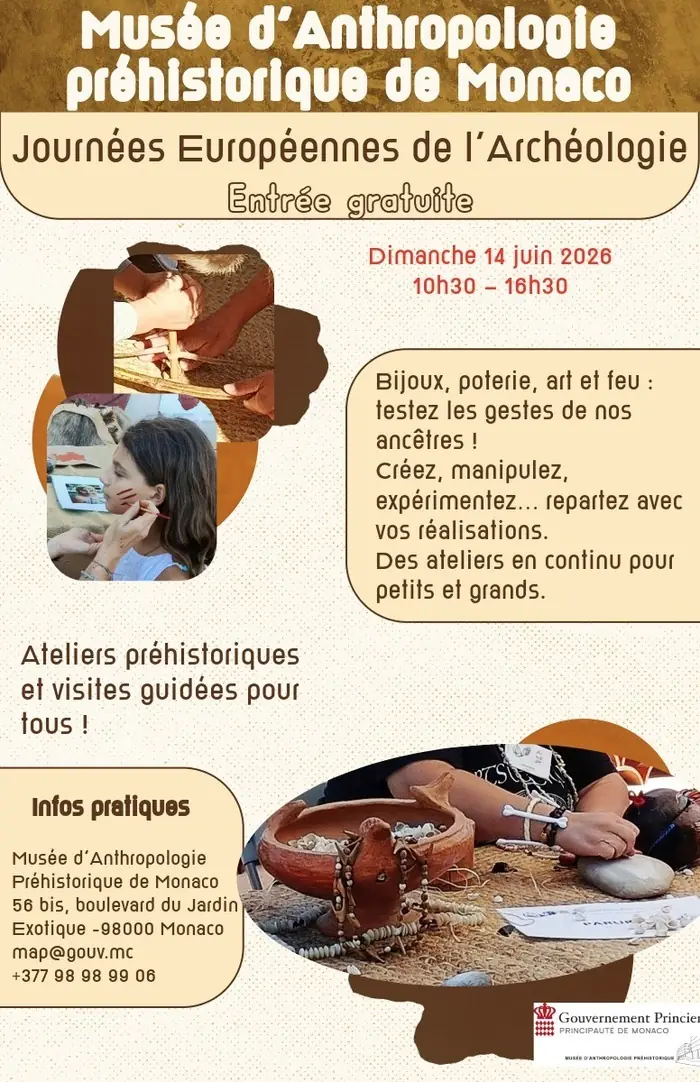
On Sunday 14 June 2026, the museum participates in the Journées Européennes de l'Archéologie — the continent-wide annual event that opens archaeological and prehistoric institutions to the general public. From 10h30 to 17h, entry is free, and the building's usual research quietude gives way to something more open and conversational. The day is structured around four parallel threads: guided visits through the permanent and temporary exhibitions, hands-on workshops running from 10h30 to 16h30, behind-the-scenes demonstrations of research methods, and direct exchanges between visitors and the museum's specialists.
Two new exhibitions anchor the 2026 programme. 'La Magie d'Ailleurs' examines ancient mysteries and ritual practices, while 'De Toumaï à Sapiens' traces human evolution from the earliest hominids to Homo sapiens in an immersive, cross-generational format. Both are presented alongside the permanent collections, which map the major stages of human development against the rhythm of glacial and interglacial periods — a timeline that makes the history of Monaco's famous casino feel like a footnote.
Fire, Clay, and the Patience of Stone
The workshop programme is where the afternoon earns its texture. Visitors can make prehistoric jewellery from clay beads, shells and plant fibres — and leave with the result. There are sessions in Neolithic pottery: shaping and decorating clay in the manner of artisans who worked this coastline thousands of years before the Romans arrived. A prehistoric painting workshop offers the techniques used to produce cave frescos. And then there is the fire-making demonstration — scheduled at 11h, 12h, 14h and 15h — in which the ancestral gestures for kindling and maintaining a flame are shown in real time.
'Il y a plus d'un million d'années, la Côte d'Azur était déjà, pour nos lointains ancêtres, un site d'habitat privilégié.' — Musée d'Anthropologie Préhistorique de Monaco
In the section titled 'Dans les Coulisses de la Recherche' — behind the scenes of research — the museum opens up its analytical methods: microscopes, scanners, dating techniques, and the quieter disciplines that turn fragments of bone and sediment into historical argument. It is the kind of access that reminds a visitor that archaeology is less about dramatic discovery than about sustained, methodical attention.
The welcome desk will have staff on hand to answer questions and assist visitors with specific needs. A boutique offers books, handcrafted objects, fossils, educational games and prehistoric-themed souvenirs — a considered selection, in keeping with an institution that takes its subject seriously.
Monaco is small enough that the museum is never more than a short climb from the waterfront, yet it occupies a mental distance from the principality's gleaming surface that feels much greater. To spend a Sunday here, in a building designed by a Monegasque architect and funded by the Princely Government, looking at evidence of a coastline occupied for a million years — is to hold the Riviera at a different angle entirely. The light on the way down the hill will look the same. You, perhaps, will not.