There is a particular quality to the light on the hill of Cimiez in early June — softer than the hard noon glare of the Promenade below, filtered through the umbrella pines that line the avenue des Arènes. It is the kind of light that makes ruins look inhabited rather than abandoned, that makes you feel the two thousand years between yourself and the Romans who once walked these same terraced slopes less like a gulf and more like a short walk downhill. On the weekend of 13 and 14 June 2026, the Musée archéologique de Cimiez leans into exactly that feeling.
The Village de l'archéologie de Nice is a two-day public event hosted at the museum's address at 160 avenue des Arènes de Cimiez. Archaeologists and cultural mediators take over the site to run hands-on workshops and open conversations — a chance, as the organisers put it, to share their discoveries, their techniques, and the quieter secrets of a profession that most people only encounter through television or textbook photographs.
Eleven Workshops, One Roman City
The programme is notably broad in its chronological reach, moving from deep prehistory to the Roman Imperial period in the space of a single afternoon. Among the workshops on offer:
- De la pierre à l'étincelle** — producing sparks by hand, as in the Prehistoric era
- L'archéo' sous l'eau** — an underwater archaeology session focused on the wreck known as Villefranche IV
- La dendrochronologie** — reading tree rings as historical documents
- Céramologie** — reassembling and identifying pottery fragments
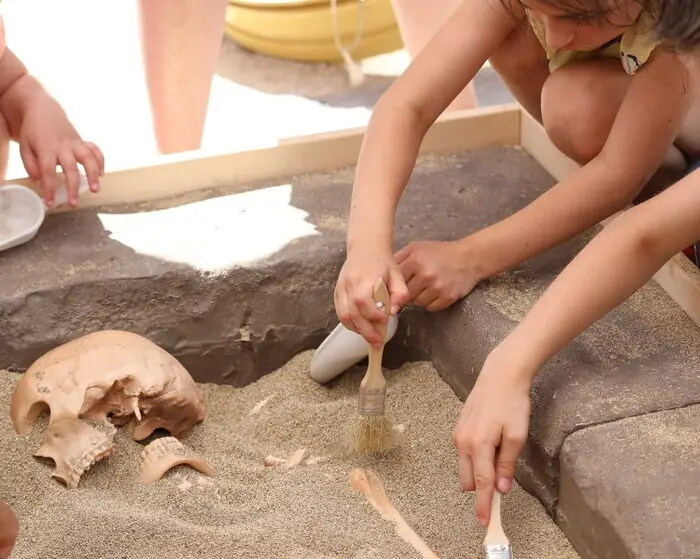
- Fouille d'une inhumation** — working alongside physical anthropologists at a burial excavation
- Archéologie biomoléculaire** — how chemistry reconstructs the daily lives of past populations
- Archéobotanique** — tracing plant use through the microscope and across the landscape
- Archéozoologie** — identifying animal and fish remains from the past
- Dans la peau d'un romain de l'Antiquité** — throwing and decorating Roman-style ceramics
- La préhistoire régionale** — an introduction to regional prehistoric sites including the Grotte du Vallonnet, Terra Amata, and the Grotte du Lazaret, with casts of hominid skulls tracing human evolution
- Bienvenue à Cemenelum** — replica objects and period dress illustrating daily life in Roman Cimiez
The range is deliberate. Archaeology, as practised here, is not a single discipline but a constellation of sciences: chemistry, botany, zoology, physical anthropology, materials analysis. The village format makes that legible to a general audience without simplifying it into mere spectacle.
The Ground Beneath the Garden
The museum's own collections give the workshops a tangible anchor. The permanent holdings document the life of Cemenelum — the Roman capital of the province of Alpes Maritimae — through objects and official documents recovered during excavations conducted between 1950 and 1969 on land acquired by the city of Nice. The site extends beyond the city itself: finds from across the broader region are represented, as are objects retrieved from the wreck of the Fourmigue C, discovered off the coast near Golfe-Juan.
Cemenelum was a city of some consequence: it served as the administrative centre of a Roman province that stretched along what is now the Franco-Italian coastline, and its amphitheatre — the ruins of which remain visible in the gardens adjacent to the museum — seated thousands. The neighbourhood of Cimiez retained its prestige long after the Romans departed; Henri Matisse spent the last years of his life here, and the Musée Matisse sits just a few hundred metres from the archaeological site. That layering of histories — prehistoric caves, Roman administration, twentieth-century modernism — is what makes the hill worth the climb at any time of year.
'Vivre à Cimiez à l'époque romaine' — the workshop title carries a quiet ambition: not to observe the past, but to inhabit it, however briefly.
For visitors arriving on the 13th or 14th, the practical advice is to allow more time than you think you need. The workshops are participatory rather than passive, and the archaeologists leading them are researchers with active fieldwork behind them — the kind of specialists who will answer a follow-up question with genuine enthusiasm rather than a rehearsed answer. Children are clearly well catered for — the spark-striking and pottery sessions in particular — but the biomolecular archaeology and dendrochronology workshops assume a curiosity that has no minimum age.
The museum is reached easily from central Nice by bus, or on foot for those willing to climb. The gardens around the Roman arena provide a natural setting for an event that is, at its core, about the relationship between a city and the earth it was built on — and what that earth continues, quietly, to give back.