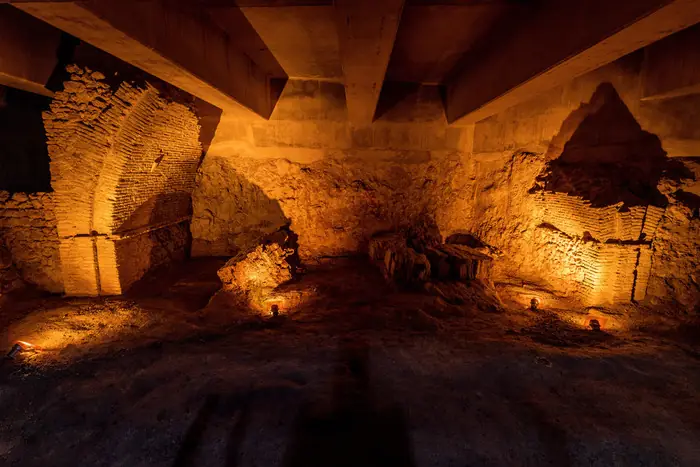
There is a particular quality of silence underground — not the silence of emptiness, but of compression, of centuries pressing in from all sides. Beneath the broad, ochre-arcaded square of Place Garibaldi, below the rumble of trams and the daily commerce of Nice's northern quarter, a vaulted chamber holds the stone memory of a city most visitors never suspect existed: a fortified stronghold whose walls once defined the boundary between the County of Provence and the ambitions of neighbouring powers.
The Accident of Discovery
The Crypte archéologique on Place Toja was not planned — it was found. In 2006, during civil engineering works for the first line of the Métropole Nice Côte d'Azur tramway, excavations broke through to a set of remarkably well-preserved remains clustered around one of the old city's principal entrances, the Porte Pairolière. What emerged from the earth was not rubble but coherent architecture: the skeleton of a fortified city that had served successively as a stronghold of the County of Provence and, later, of the Duchy of Savoy. The site offered an unbroken stratigraphic narrative stretching from the Middle Ages forward — an exceptional find in a Mediterranean city whose upper layers have been so thoroughly rebuilt.
The fortifications themselves had a decisive, if violent, end. In 1706, on the orders of Louis XIV, the defences were demolished — a strategic erasure that condemned the structures to three centuries of oblivion beneath the growing city. What the tramway workers uncovered was, in a sense, the consequence of that royal command: destruction so thorough that the stones simply sank and were forgotten, and in forgetting, were preserved.
What the Visit Offers
On 13 and 14 June 2026, the Centre du Patrimoine opens the crypt for guided visits beginning at noon, led by an archaeologist who participated in the original excavations. That distinction matters. The difference between a guide who has read the history and one who has worked the trench — who has felt the resistance of compacted soil give way to dressed stone — is the difference between a map and a journey. Expect a reading of the site that is precise, specific, and grounded in the physical evidence rather than general narrative.
The underground room sits beneath Place Garibaldi and the Boulevard Jean Jaurès, and it presents the military history of Nice through the actual vestiges of its fortified city: walls, defensive structures, and the traces of the Porte Pairolière that once controlled movement into the urban core. The visit illuminates how the city's defensive system evolved across the medieval and early modern periods — a story of shifting sovereignty and strategic geography that shaped the physical form of Nice long before the Belle Époque villas and the Promenade des Anglais defined its modern image.
Practical notes for those planning to attend:
- Rendez-vous at Place Jacques-Toja; flat-soled shoes are advised for the underground terrain
- Groups are capped at 15 people per session; reservations are strongly recommended
- Bookings via telephone at 04 92 00 41 90 or by email at centredupatrimoine@ville-nice.fr
- Further information and online reservations at the Centre du Patrimoine website
Nice rewards those who look past its luminous seafront. The city's identity was formed not on the shore but on the hill — the Colline du Château, the fortified perimeter, the contested passes between Alpine powers. The Crypte archéologique is among the few places where that older, harder history becomes tangible: not reconstructed, not illustrated, but physically present underfoot. An hour spent here reorients the rest of the city above, lending even the familiar arcades of Place Garibaldi a new, layered weight.