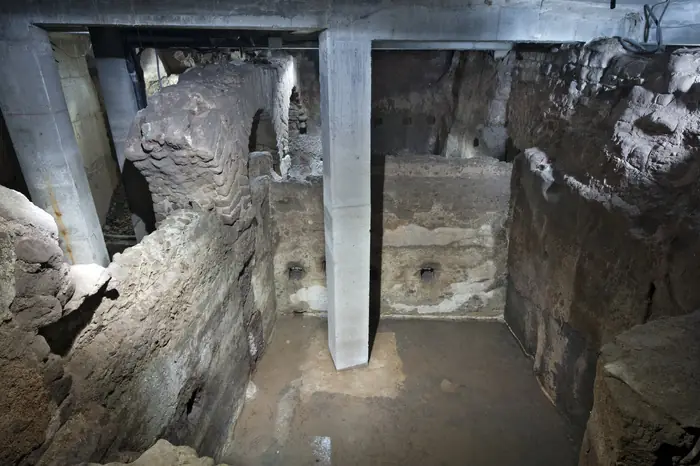
There is a particular quality of silence underground — not the absence of sound, but a presence of its own, something the Romans understood instinctively when they built along the edge of their harbour at Forum Iulii. On Saturday 13 June 2026, two small groups of visitors will step beneath the modern city of Fréjus into a crypt that holds one of the most unexpected Roman survivals in the south of France: a working fish pond, or vivier, constructed at the margins of what was once one of the most strategically significant ports on the Mediterranean coast.
The visits depart at 10h00 and 11h00, each limited to fifteen people, from the Crypte archéologique du vivier romain at 305 Avenue Aristide Briand. That limit is not incidental — the space demands it. A guided commentary accompanies the descent, leading guests through the dim interior where the structure has rested, largely undisturbed, for nearly two millennia.
A Discovery Beneath the Pavement
The story of how this place came to light is itself worth the visit. Around fifteen years ago, construction workers carrying out routine works in Fréjus broke through into something they had not expected: a Roman fish pond, intact in its essential form, hidden beneath the fabric of the contemporary city. The site is now classified as a Monument Historique, a designation that acknowledges not merely its age but its rarity — vivaria of this kind, purpose-built enclosures for keeping live fish adjacent to a harbour, are exceptionally uncommon finds in France.
Fréjus itself — Forum Iulii in the Roman nomenclature — was founded in the first century BC and developed under Augustus into a naval base of considerable importance. The harbour, now silted and landlocked several kilometres from the current coastline, once sheltered the fleet that fought at the Battle of Actium. The city retains more Roman fabric than almost anywhere else in Provence: an amphitheatre, an aqueduct, the remains of a theatre, city walls. The vivier sits within this layered geography, one more proof that the ground beneath a Provençal street is rarely as straightforward as it appears.
What the Crypt Holds
The guided visit moves through what the original description calls l'obscurité mystérieuse de la crypte — the mysterious darkness of the crypt. That is not atmospheric licence; it is simply the condition of being underground in a structure that predates electric light by roughly two thousand years. The commentary contextualises the engineering: how the Romans maintained seawater circulation in such enclosures, why a fish pond adjacent to a port made practical sense in a culture where fresh seafood carried both nutritional and social weight, and how the structure relates to the wider Roman urban plan of Forum Iulii.
For visitors already acquainted with the more visible Roman monuments of Fréjus, the vivier offers something the amphitheatre and the aqueduct cannot — genuine intimacy with a single, specific function of Roman daily life. The scale is domestic rather than monumental. You are not standing before an expression of imperial ambition; you are standing in a working room.
The practical details are simple: - Two sessions: 10h00 and 11h00, Saturday 13 June 2026 - Maximum 15 persons per visit - Address: 305 Avenue Aristide Briand, 83600 Fréjus - Further information: frejus.fr
Fréjus is forty minutes east of Saint-Raphaël by the coastal road, or reachable directly by TGV from Nice and Marseille. The Avenue Aristide Briand runs through a part of the city where Roman traces surface with quiet regularity, and the crypt sits within that larger archaeological conversation.
There are mornings on the Côte d'Azur in June when the light is so insistent, so coastal-bright, that the idea of going underground seems almost perverse. And then you do, and the temperature drops, and the commentary begins, and fifteen people stand very still around a fish pond that nobody knew existed until a construction crew accidentally found it — and the morning outside, with all its brightness, becomes temporarily beside the point.