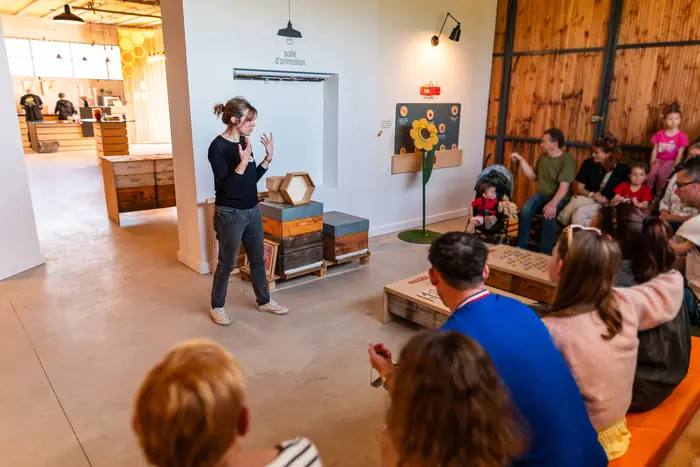
There is a particular quality to the air in the Var in early June — warm without yet being heavy, carrying the last of the mimosa's ghost and the first real heat of summer. Along the chemin de l'Angueiroun, a narrow lane winding through the maquis above Bormes-les-Mimosas, that air smells faintly of beeswax and wildflower. It is the kind of detail you notice only when you slow down, which is precisely what La Butinerie asks of you.
On 5 and 6 June 2026, this working honey farm and bee museum opens its doors for guided visits — a rare chance to step inside a genuine site of production rather than a reconstructed display. La Butinerie sits at 1509 chemin de l'Angueiroun, and the visit runs approximately 45 minutes, concluding with a honey tasting. Entry is €6 per person; children under 16 are admitted free. The site is fully accessible for pushchairs and visitors with reduced mobility.
From Flower to Jar
The Var has long been bee country. The garrigue that covers these hills — rosemary, thyme, lavender, cistus — constitutes one of the richest foraging landscapes in France, and Provençal honey has carried protected designations for generations. What La Butinerie offers is not a museum in the conventional sense but an immersion in a place where honey is still made, season after season, by people who understand the work intimately.
The guided tour moves through the full arc of production: the journey of nectar from flower to pot, the internal logic of the colony, and the daily rhythms of the beekeeper across the year. A living, observation hive allows visitors to watch the colony at work without any direct contact with the bees — an arrangement that makes the experience suitable for children and the genuinely curious alike. Multimedia installations, described as life-size, fill in what the eye alone cannot follow: the waggle dance, the caste structure, the mathematics of a working hive.
"On comprend le métier d'apiculteur et son engagement humain et environnemental" — the producers themselves frame their work in those terms, human and environmental commitment together.
That framing matters. The visit is structured around the beekeeper as a figure — not an abstraction, but someone whose choices about site, season, and method determine what ends up in the jar. The multimedia installation follows a single apiculteur through the year, from the first inspections of spring to the autumn extraction. It is, in effect, a portrait of a profession that most people encounter only at the market stall.
What the Visit Holds
For those planning the day, the programme at La Butinerie covers:
- The complete journey of honey, from flowering plant to finished pot
- A living, immersive observation hive
- Life-size multimedia installations on bee behaviour and colony organisation
- The beekeeper's trade explained by practitioners
- A honey tasting at the close of the guided tour
Bormes-les-Mimosas itself rewards the journey. The medieval village above — its lanes tumbling with bougainvillea, its views reaching across the Maures massif toward the Îles d'Hyères — is one of the most photographed in the Var, and rightly so. But the commune's character is not solely scenic. It has a working agricultural hinterland, and La Butinerie sits within that landscape rather than apart from it. Coming here on a June morning, before the heat settles in properly, feels like catching a place at its most candid.
The tasting that closes the visit is not a formality. Provençal honeys vary considerably by forage — a lavender honey from the plateau differs from one gathered on coastal garrigue — and sampling with the producers on hand to explain what you are tasting is a different exercise from reading a label in a shop. It is the kind of knowledge that travels home with you, changing how you reach for a jar.
For families making their way along the Côte d'Azur this early June, or for anyone who has ever stood at a Provençal market wondering at the amber gradations in a row of honey pots, the chemin de l'Angueiroun is worth the detour.