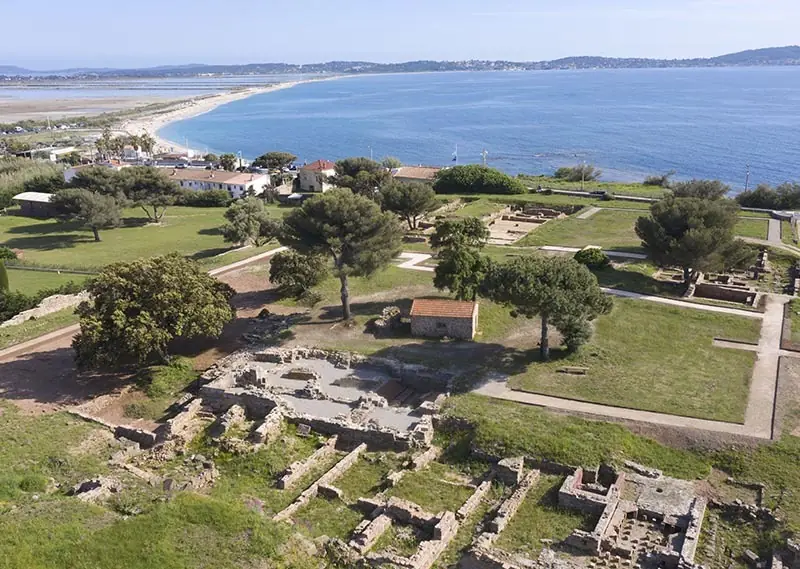
The coast between Hyères and the Giens peninsula holds the kind of light that painters have always chased — low and salt-softened, bouncing off the shallows of the Almanarre lagoon. It is easy, driving this stretch of the Var coast, to register only the wind and the kite-surfers. Harder to notice the slight rise in the land just back from the shore, the neat geometry of ancient stone poking through scrub, the ghost of a city that has been here, in one form or another, for roughly 2,400 years.
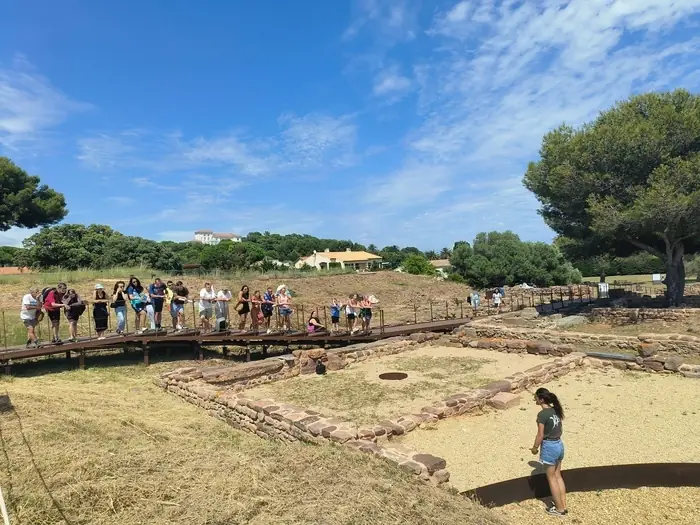
This is Olbia — and on 13 and 14 June 2026, the archaeological site opens its stones to a different kind of attention. A guided commentary walk, 'Une forteresse grecque', takes visitors through the vestiges with a trained mediator who reads the ruins as both archaeological evidence and historical narrative. The visit lasts around an hour and a half, begins at noon on both days, and requires no advance reservation — places are available on a first-come basis at the site on Route de l'Almanarre, 83400 Hyères.
A Colony Built to Last
Olbia was founded in the fourth century BC by Massalia — the Greek city we now call Marseille — as part of a network of fortified colonies designed to protect maritime trade routes along the Ligurian coast. Its settlers were soldier-colonists: men who fished, farmed, and kept watch over the sea lanes simultaneously. What distinguishes Olbia from almost every comparable site in the western Mediterranean is a matter of preservation: this is the only known Greek fortress-colony of the Massalian network whose complete urban plan has survived intact above ground.
'Les premiers Olbiens étaient des soldats-colons, pêcheurs, agriculteurs' — their mission, above all, was to secure the sea.
The vestiges that have been excavated and consolidated here represent a full millennium of urban life. Visitors can trace the fortification walls, walk streets that were once fitted with gutters and raised pavements, identify the collective well that served an entire neighbourhood, and pick out the footprints of individual houses, workshops, thermal baths, and sanctuaries. The city evolved continuously from its Hellenistic founding through the Roman period and beyond — and the trained eye, guided by a mediator who knows how to point, can follow that evolution layer by layer. Discovered on the same site, the ruins of a medieval abbey, Saint-Pierre de l'Almanarre, add a further chapter to a landscape that refuses to belong to any single century.
What the Visit Offers
The format is deliberately accessible. There is no ticketing apparatus, no timed-entry system, no audio guide competing with the wind. A human mediator leads the group, offering what the site itself describes as an 'archéologique et historique' reading of the remains — meaning the commentary moves between the physical evidence underfoot and the broader story of who built it, why, and what happened next. The surrounding landscape — the coastal promontory, the lagoon, the long sight-lines toward the Îles d'Hyères — is treated as part of the experience, not a backdrop to it.
For a visitor arriving from Nice or Cannes, Hyères represents a deliberate step off the more theatrical stretch of the Côte d'Azur. The town itself, with its medieval hilltop quarter and its Belle Époque villas, was a fashionable winter resort for the English and Russian aristocracy in the nineteenth century — Queen Victoria came; Robert Louis Stevenson wrote here. The Olbia site sits at the quieter, wilder end of the commune, where the land narrows toward the peninsula and the sea asserts itself on both sides.
Practical considerations are few: - No reservation required — arrive at the site before noon on either day - Duration: approximately 1 hour 30 minutes - Entry is subject to available places on the day - The site address: Route de l'Almanarre, 83400 Hyères
June on this coast means long evenings and a Mistral that occasionally freshens the heat into something almost Nordic. The ruins of Olbia, exposed to that same wind for twenty-four centuries, have a quality that indoor museums rarely replicate — the sense that the past is simply present, lying in the open air, waiting for someone to ask the right questions. A guided walk through a Greek fortress at midday, with the Var hills behind and the Mediterranean ahead, is precisely the kind of occasion that rewards curiosity over spectacle.